Articles

Mental Health and Klinefelter Syndrome: Anxiety, Depression and Support in India
A Klinefelter Syndrome diagnosis affects more than just your physical health. For many men, the emotional and psychological impact is just as significant as the hormonal changes. Research consistently shows that men with KS experience higher rates of anxiety and depression than the general male population[1], and the weeks and months following diagnosis often bring intense emotional challenges. This article addresses the mental health dimension of Klinefelter Syndrome directly and honestly. It covers why mental health struggles are common in KS, what the research shows, how to recognize when you need help, what treatment options work, and where to find support in India. This is not about weakness or failure. This is about understanding a real and well-documented part of the condition and taking care of your mental health with the same seriousness you bring to your physical health.Why Mental Health Matters in Klinefelter Syndrome The connection between Klinefelter Syndrome and mental health operates on two levels. The biological level: Low testosterone levels, which are common in KS, are directly associated with increased rates of depression, anxiety, and mood instability[1]. Hormones affect brain chemistry, and when testosterone is chronically low, the brain does not function optimally. This is not a character flaw. It is biochemistry. The psychological and social level: Receiving a KS diagnosis is a significant life event. Learning that you have a genetic condition you were unaware of, that fertility may be affected, that lifelong treatment may be needed, and that your body functions differently than you thought - all of this creates genuine psychological stress. Research shows that men with KS report higher levels of social anxiety, difficulty with emotional regulation, and challenges with executive function and verbal processing[2]. These are not universal experiences, but they are common enough to be well-documented in medical literature. What matters most is this: mental health challenges in KS are real, they are common, and they are treatable. Ignoring them does not make them go away. Addressing them directly, with the same practical approach you bring to managing your physical health, makes a meaningful difference in quality of life. The weeks immediately following diagnosis are often the most emotionally difficult. This is normal. Most men find that the intensity of emotions settles over time as uncertainty is replaced with information and treatment begins. But if difficult emotions persist beyond two to three months, or if they interfere significantly with daily life, professional support can help.Common Mental Health Challenges in Klinefelter Syndrome Anxiety Anxiety is one of the most frequently reported mental health challenges in men with KS[2]. This can manifest as generalized worry, social anxiety, health anxiety after diagnosis, or specific fears around fertility and relationships. Some men describe a persistent sense of unease or dread that is difficult to pin down to any single cause. The biological component matters here. Low testosterone is linked to increased anxiety sensitivity. The psychological component also matters - a diagnosis that changes your understanding of your body and your future naturally triggers worry. Both dimensions are valid, and both can be addressed through treatment. Common anxiety symptoms in the KS context include excessive worry about health outcomes, difficulty relaxing or sleeping due to racing thoughts, avoidance of medical appointments due to fear, social withdrawal or discomfort in group settings, and physical symptoms like rapid heartbeat, sweating, or tension that have no clear medical cause. Depression Depression rates are elevated in men with Klinefelter Syndrome compared to the general male population[1][2]. This can range from persistent low mood and lack of motivation to more severe depressive episodes. Common symptoms include fatigue that does not improve with rest, difficulty finding pleasure in activities that used to matter, changes in sleep and appetite, difficulty concentrating, and in some cases thoughts of worthlessness or hopelessness. It is important to distinguish between reactive depression - a natural response to a difficult diagnosis - and chronic depression that may have been present before diagnosis but went unrecognized. Both are real. Both deserve treatment. The first often improves with time, support, and adjustment. The second typically requires more active intervention. Adjustment Challenges After Diagnosis The period immediately following diagnosis is psychologically difficult for most men. This is not a diagnosable mental health condition in itself, but it is a real adjustment process. Common experiences include shock and disbelief ("This can't be right"), anger at the unfairness of a genetic condition you did not choose, grief over lost expectations particularly around fertility, confusion about what the diagnosis means for your future, and a sense of isolation or difference from other men. These reactions are normal. They do not mean you are handling the diagnosis poorly. They mean you are processing a significant piece of information about your life and your health. Most men find that these intense emotions settle over weeks to months, particularly with support and accurate information[5]. If they do not settle, or if they intensify, that is a signal to seek help. Social Anxiety and Isolation Some men with KS report longstanding social anxiety or difficulty with social interactions that predates diagnosis[2]. This may be related to subtle differences in verbal processing or executive function, or it may simply be temperament. After diagnosis, some men withdraw further, feeling different or damaged in ways that make connection harder. This withdrawal is understandable but ultimately harmful. Social connection is protective for mental health. Isolation makes anxiety and depression worse. Breaking the cycle of withdrawal is one of the most important interventions you can make for yourself, even when it feels difficult or uncomfortable.Recognizing When You Need Help Not every difficult emotion requires professional intervention. Sadness after diagnosis is normal. Worry about the future is normal. Anger at the unfairness of a genetic condition you did not choose is normal. These feelings deserve acknowledgment and time, but they do not always require therapy or medication. Professional help becomes important when:Difficult emotions persist beyond the initial adjustment period of two to three months Emotions interfere significantly with your daily life - work, relationships, or self-care You find yourself withdrawing from people and activities that used to matter Sleep or appetite changes are severe or prolonged (more than two weeks) You experience thoughts of self-harm or suicide Physical symptoms like fatigue, headaches, or body pain have no clear medical cause You are using alcohol or other substances to manage emotionsIf you are unsure whether what you are experiencing warrants help, err on the side of talking to someone. A single conversation with a counselor or your doctor can clarify whether what you are experiencing is part of normal adjustment or something that would benefit from intervention. There is no penalty for asking. There is no minimum threshold of suffering required to deserve support. If you are struggling, that is reason enough to reach out.What Treatment Works Mental health treatment for men with Klinefelter Syndrome is not fundamentally different from treatment for anyone else, but there are KS-specific considerations worth understanding. Testosterone Replacement Therapy If your testosterone is low and you are experiencing depression or anxiety, starting TRT often improves mood significantly[3]. This is not a replacement for mental health treatment, but it addresses one of the biological contributors to poor mental health in KS. Many men report that energy, motivation, and emotional stability improve within weeks to months of starting testosterone therapy. However, TRT alone is not a complete solution. If depression or anxiety persists despite adequate testosterone levels, additional intervention is needed. Hormones are one piece of the puzzle, not the entire answer. Your endocrinologist can assess whether low testosterone is contributing to your mental health challenges. Psychotherapy and Counseling Talk therapy works. Cognitive behavioral therapy (CBT), which focuses on identifying and changing unhelpful thought patterns, has strong evidence for treating both anxiety and depression. For men dealing with adjustment to a chronic diagnosis, therapy provides a structured space to process emotions, develop coping strategies, and work through fears about the future. Finding a therapist who understands chronic health conditions is helpful, though not essential. What matters more is finding someone you trust and feel comfortable talking to. Therapy does not need to be long-term - even a few months of focused work can make a meaningful difference. In India, therapy sessions typically cost ₹800 to ₹2,500 per session in private practice, or ₹200 to ₹500 per session at government hospital psychiatry departments. Online therapy platforms have made access easier, particularly for men in smaller cities. Medication Antidepressants and anti-anxiety medications are options worth considering if symptoms are severe or not responding to therapy alone. SSRIs (selective serotonin reuptake inhibitors) such as sertraline or escitalopram are commonly prescribed by psychiatrists and are effective for both depression and anxiety. These medications are not addictive, they do not interact negatively with testosterone therapy, and for many people they provide significant relief. Medication is not a sign of failure. It is a tool. The goal is to feel better and function well, not to avoid medication out of principle. Your endocrinologist may be comfortable prescribing antidepressants for straightforward cases, or they may refer you to a psychiatrist for medication management. Psychiatrist consultation costs in India range from ₹800 to ₹3,000 in private practice, or ₹300 to ₹800 at government hospitals. Lifestyle Interventions These sound simple, but they work. Regular exercise, particularly strength training and cardiovascular activity, has strong evidence for improving both depression and anxiety[4]. Adequate sleep is non-negotiable - poor sleep worsens every mental health condition. Social connection, even when you do not feel like reaching out, is protective. Reducing alcohol intake matters because alcohol is a depressant and worsens anxiety over time. These are not replacements for therapy or medication when those are needed, but they are powerful supports alongside formal treatment. Think of them as the foundation that makes other treatments more effective.Finding Mental Health Support in India Mental health support in India has improved significantly in recent years, though access and affordability remain challenges depending on where you live. Finding a Therapist or Psychologist Online therapy platforms such as Practo Mind, MindPeers, and BetterLYF connect you with licensed psychologists and counselors. Sessions are typically conducted via video call, which removes geographical barriers. Costs range from ₹800 to ₹2,500 per session depending on the platform and therapist experience. Many platforms offer an initial consultation at reduced rates. In-person therapy is available in major cities through private practices, hospitals with psychiatry departments, and mental health clinics. Government medical college hospitals (such as NIMHANS in Bangalore, AIIMS in Delhi, or Lokmanya Tilak Municipal Medical College in Mumbai) often have psychiatry and clinical psychology departments where costs are significantly lower - typically ₹200 to ₹500 per session - though wait times can be longer. When searching for a therapist, you do not need to find someone who specializes in Klinefelter Syndrome specifically. What matters is finding someone experienced in chronic illness adjustment, men's mental health, or general anxiety and depression treatment. Good therapists will listen, ask questions, and educate themselves about KS if needed. Psychiatrists and Medication Management If medication is part of your treatment plan, you will need a psychiatrist to prescribe and monitor it. Psychiatrists are medical doctors who can diagnose mental health conditions and prescribe medication. Many endocrinologists are comfortable prescribing antidepressants for straightforward cases, so ask your KS doctor if they can manage this or if they recommend a referral to a psychiatrist. This can save you time and consultation costs. Psychiatrist consultation costs in India:Private practice: ₹800 to ₹3,000 for initial consultation Government hospitals: ₹300 to ₹800 Follow-up appointments: Usually shorter and less expensive (₹500 to ₹1,500 in private, ₹200 to ₹500 in government)Crisis Support and Helplines If you are in immediate distress or experiencing thoughts of self-harm, crisis support is available 24/7 in India:Kiran (National Mental Health Helpline): 1800-599-0019 (toll-free, multilingual) NIMHANS Helpline (Bangalore): 080-46110007 Vandrevala Foundation: 1860-2662-345 iCall (Tata Institute): 9152987821These services are free, confidential, and staffed by trained counselors. If you are in crisis, use them. They exist for exactly this purpose. Support Groups and Peer Connection There is no established Klinefelter Syndrome support group network in India at this time, though online communities exist internationally. General chronic illness support groups, men's mental health groups, and infertility support groups may provide valuable connection even if they are not KS-specific. Peer support matters. Talking to someone who understands what living with a chronic condition feels like - even if the specific condition is different - reduces isolation and provides perspective that clinical treatment alone cannot offer. Cost Comparison: Mental Health Services in IndiaService Type Government/Public Private Online PlatformPsychologist/Counselor ₹200-₹500/session ₹1,500-₹3,000/session ₹800-₹2,500/sessionPsychiatrist Consultation ₹300-₹800 ₹1,000-₹3,000 ₹1,000-₹2,000Crisis Helpline Free N/A FreeAntidepressant Medication ₹50-₹300/month ₹200-₹800/month Same (requires prescription)Common Questions Q: Will starting TRT fix my depression and anxiety? It often helps significantly, but it is not a complete solution for everyone. If low testosterone is contributing to your mental health struggles, bringing it into the normal range frequently improves mood, energy, and emotional stability within weeks to months[3]. However, if depression or anxiety persists despite adequate testosterone levels, additional treatment such as therapy or medication is needed. Think of TRT as addressing one important contributing factor, not as a cure for all mental health challenges. Your endocrinologist can monitor both your testosterone levels and mood symptoms to assess the connection. Q: Is it normal to feel worse before feeling better after diagnosis? Yes, this is common. The first few weeks to months after diagnosis are often the most emotionally difficult. Learning that you have a lifelong genetic condition, processing what it means for fertility and relationships, and adjusting your understanding of your body all take time. Most men find that emotional intensity peaks in the first month and gradually settles over two to three months as information replaces uncertainty and treatment begins[5]. If it does not settle, or if it gets worse instead of better, that is a signal to seek professional support. Q: Should I tell my therapist I have Klinefelter Syndrome? Yes. Your therapist cannot help you effectively if they do not understand the full context of what you are dealing with. Klinefelter Syndrome is relevant because it affects hormones, fertility, physical health, and potentially cognitive and emotional processing. Most therapists will not be familiar with KS specifically, but good therapists will listen, ask questions, and educate themselves as needed. You can bring one of the foundation articles from KlinefelterIndia.org if it helps explain the condition clearly. A therapist who dismisses the relevance of your diagnosis or refuses to learn about it is not the right therapist for you. Q: How do I know if I need medication or just therapy? This is a decision to make with your doctor or psychiatrist based on symptom severity and what has or has not worked so far. Generally, mild to moderate depression and anxiety can often be managed with therapy alone, particularly if symptoms are recent and clearly tied to the diagnosis. Severe depression, persistent anxiety that does not respond to therapy after several months, or symptoms that significantly impair daily functioning often benefit from medication alongside therapy. There is no shame in either path. The goal is to feel better, not to avoid medication. If you try therapy for 2-3 months and symptoms have not improved meaningfully, discuss medication with your doctor.What to Do Next If you are struggling emotionally after a KS diagnosis, or if mental health challenges have been part of your experience for longer, the most important step is to talk to someone. Your immediate action steps:Start with your current doctor if that feels most comfortable. Your endocrinologist or general physician can assess whether low testosterone is contributing to mood symptoms and provide referrals to mental health professionals. This is a normal part of comprehensive KS care. Book a therapy session if you prefer direct access. Online platforms such as Practo Mind, MindPeers, or BetterLYF allow you to book a session within days. Cost should not be a barrier - government hospital psychiatry departments offer affordable care (₹200-₹500 per session), and some online platforms offer sliding scale fees. Call a crisis helpline immediately if you are experiencing thoughts of self-harm. Kiran (1800-599-0019) is free, confidential, and available 24/7 in multiple languages. This is what these services exist for. Give treatment time to work. Therapy shows meaningful results after 4-6 sessions. Antidepressant medications take 4-6 weeks to reach full effect. TRT improves mood over 2-3 months. Do not expect overnight changes, but do expect gradual improvement. Be honest with your support system. Tell at least one trusted person - family member, friend, partner - what you are experiencing. Isolation makes everything worse. Connection helps.Mental health is not separate from physical health. Treating one without addressing the other leaves you only partially cared for. You deserve comprehensive support for all dimensions of living with Klinefelter Syndrome, and that includes your mental and emotional wellbeing. The right support exists. You just need to take the first step toward finding it.Medical Disclaimer: This article provides educational information about mental health aspects of Klinefelter Syndrome. It is not medical advice and does not replace consultation with qualified healthcare providers. The Author is not a medical professional or mental health specialist. If you are experiencing mental health difficulties, consult qualified psychiatrists, psychologists, or counselors for proper evaluation and treatment. If you are in crisis, contact emergency services or crisis helplines immediately.
- Editor
- 15 Apr, 2026
The First 90 Days After a Klinefelter Syndrome Diagnosis
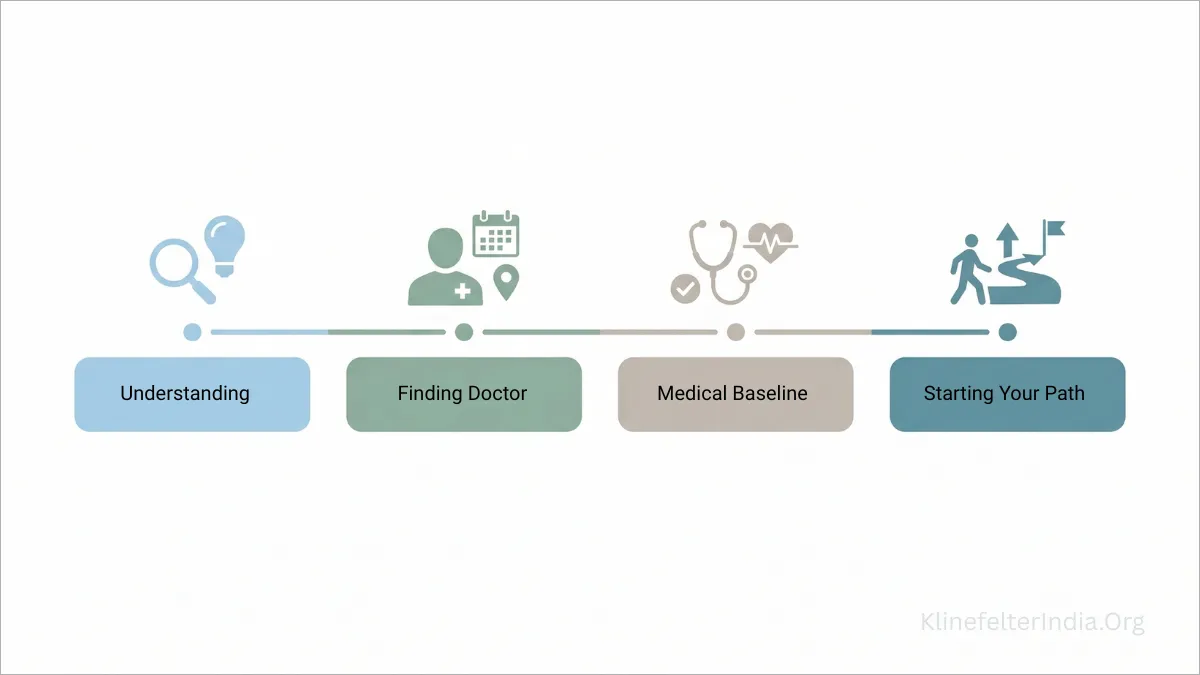
Key Takeaways: Initial Phase: The first 90 days should focus on adjusting and getting baseline tests. Specialists: Secure appointments with qualified endocrinologists for long-term health. No Rush: Take time to understand your diagnostics before initiating therapy.A Klinefelter Syndrome diagnosis can feel overwhelming. One moment you are living your normal life, and the next you are looking at a karyotype report showing 47,XXY - a chromosome pattern you have never heard of before. Questions flood in immediately. What does this mean? What do I do now? Is my health at risk? Can I still have children? This reaction is completely normal. Most men diagnosed with Klinefelter Syndrome - especially adults diagnosed during fertility investigations - feel a mix of confusion, anxiety, and sometimes relief that they finally have answers for things that have felt wrong for years. This guide gives you a clear, week-by-week action plan for the first 90 days after diagnosis. No overwhelm, no medical jargon, just practical steps in order with India-specific costs and resources. Follow this plan, and by day 90 you will have a solid understanding of your condition, a qualified doctor managing your care, a treatment plan in place, and a clear path forward. Why the First 90 Days Matter The first three months after diagnosis set the foundation for everything that follows. The decisions you make now - which doctor to see, whether to start treatment, what to do about fertility - shape the next several years of your health and wellbeing. The good news is that you do not need to figure everything out at once. Klinefelter Syndrome is manageable. Millions of men worldwide live full, healthy lives with 47,XXY chromosomes[1]. The key is taking the right steps in the right order without rushing or skipping stages. This plan breaks 90 days into four clear phases. Each phase builds on the previous one. If you are feeling overwhelmed right now, just focus on Week 1. The rest will follow naturally. Before You Start - What You Need to Know Three things are important to understand before you begin working through this plan. First, Klinefelter Syndrome is not a medical emergency. You do not need to rush to a hospital today. Most men with KS go years, sometimes decades, without diagnosis and without serious immediate harm. You have time to research properly, find the right doctor, and make informed decisions rather than rushed ones. Second, your fertility timeline matters, but do not panic. If having biological children is important to you, acting within the first few weeks to months is valuable - but not because fertility disappears overnight. It is because starting testosterone replacement therapy later will suppress whatever remaining sperm production exists. Discussing fertility with your doctor early keeps your options open. This is important but not an immediate crisis. Third, you are not alone in this. Klinefelter Syndrome affects approximately 1 in 500 to 1,000 males[2]. In India, that translates to an estimated 700,000 to 1.4 million men, the vast majority of them undiagnosed. You are joining a large community of men navigating this same journey, even if most of them remain invisible. Phase 1 - Understanding (Days 1 to 7) The first week is about understanding what Klinefelter Syndrome actually means for you - not just medically, but emotionally as well. Days 1 to 2 - Process the Diagnosis Give yourself permission to feel whatever you are feeling. Shock, confusion, sadness, anger, relief - all of these are normal reactions to a life-changing diagnosis. You do not need to have everything figured out immediately, and you do not need to make any decisions yet. Just sit with the information for a day or two. Talk to someone you trust if you are ready to. This could be your partner, a close friend, or a family member. You do not need to explain everything in detail right away. Even saying "I received some health news and I am still processing it" is enough to open the door to support. Days 3 to 5 - Learn the Basics Read the foundational articles to understand what Klinefelter Syndrome actually means. Start with the What is Klinefelter Syndrome article, which covers what the condition is, what it is not, and what it means for your body. Then read the Klinefelter Syndrome Symptoms and Diagnosis article, which helps you understand which symptoms are connected to KS and which are not. What you are building here is a calm, factual understanding of your condition. Not every concerning symptom you find online will apply to you. Many men with KS have mild symptoms and live very normal lives. The goal of these first few days is to replace panic with accurate information. Days 6 to 7 - Make Your Decision List Write down the questions and decisions that lie ahead of you. A simple written list helps reduce the mental chaos. Do you want biological children someday? Do you have symptoms that are affecting your daily life right now? Do you have a general physician you trust who can give you a referral? What is your realistic budget for initial consultations and tests? Keep this list. You will bring it to your first doctor appointment and use it to guide your questions. Writing things down makes the path ahead feel more manageable. Phase 2 - Finding Your Doctor (Days 8 to 21) Week 2 - Identify and Screen Doctors Finding the right doctor is the single most important action in the first 90 days. Everything else - tests, treatment, fertility decisions - flows from having a qualified doctor who understands Klinefelter Syndrome. The type of doctor you need is an endocrinologist, a hormone specialist. If fertility is your primary concern, an andrologist - a male reproductive specialist - is ideal, though they are less common and mainly found in fertility clinics in major cities. To find potential doctors, start by searching hospital websites for endocrinology departments in your city. Doctor platforms such as Practo or Lybrate allow you to filter by specialty. Ask your general physician for a referral. Call clinics directly and ask whether the doctor treats Klinefelter Syndrome patients. When you call to screen doctors, ask these specific questions. Does the doctor have experience with Klinefelter Syndrome? How many KS patients does the doctor currently treat? What is the first consultation fee? What is the typical wait time for an appointment? The answers will tell you whether this doctor is worth booking with. The Finding a Klinefelter Doctor in India guide covers this process in complete detail, including red and green flags to watch for during consultations. Week 3 - Book and Prepare for Your Consultation Book an appointment with your top choice. Appointments with good specialists typically take one to two weeks to get, so book early and use the waiting time to prepare. Gather these documents before your appointment. Your karyotype report, which is the test that confirmed your 47,XXY diagnosis. Any previous blood test results you have. Your semen analysis report if one was done during fertility investigations. The decision list you wrote in Week 1. A written list of questions you want answered. Consultation costs vary significantly depending on where you go. Government hospitals charge approximately ₹300 to ₹800. Private hospitals run ₹1,000 to ₹2,500. Premium hospitals can charge ₹2,000 to ₹5,000. Budget accordingly and remember that the first consultation is typically the most expensive. Phase 3 - Medical Baseline (Days 22 to 60) Week 4 - First Consultation Your first appointment with an endocrinologist will typically last 30 to 45 minutes if the doctor is thorough. The doctor will review your karyotype, ask about your symptoms, examine you physically, and discuss treatment options. Key points to raise during this consultation: you want to understand what Klinefelter Syndrome means for your long-term health. You want to know what tests are needed before starting any treatment. If children matter to you, explicitly state that you want to discuss fertility options before making any decisions about treatment. Ask what the monitoring plan looks like long term. A good doctor will welcome these questions and take time to answer them properly. If the doctor seems rushed, dismissive, or unwilling to discuss fertility, that is a red flag. Consider seeking a second opinion. Weeks 5 to 6 - Baseline Blood Tests Your doctor will order a panel of blood tests to establish your current hormone levels and overall health before any treatment begins. These are your baseline measurements. The table below shows the key tests, what they measure, and why each matters.Test What It Measures Why It MattersTotal Testosterone Your current testosterone level Determines if TRT is neededFree Testosterone Testosterone available to your body More accurate than total aloneLH (Luteinizing Hormone) Signals testes to produce testosterone Usually elevated in KSFSH (Follicle Stimulating Hormone) Related to sperm production Usually elevated in KSEstradiol Estrogen level Important for bone health monitoringCBC (Complete Blood Count) Blood cell counts Baseline before TRTLiver Function Tests Liver health Important if oral testosterone consideredVitamin D Bone health marker Often low in KSLipid Profile Cholesterol levels Cardiovascular health baselineDEXA Scan Bone density Optional but recommendedEstimated lab costs at private facilities in India: full hormone panel approximately ₹1,500 to ₹3,000, complete blood count and liver function tests ₹500 to ₹800, Vitamin D test ₹300 to ₹500, lipid profile ₹400 to ₹600, and DEXA bone density scan if ordered ₹2,000 to ₹4,000. Where to get tests done: government hospital labs are the cheapest option at 40 to 60 percent less than private labs. Private chains such as Thyrocare, Dr. Lal PathLabs, SRL, and Metropolis offer convenience and home collection. Your doctor may provide a referral to a specific lab they work with regularly. Weeks 7 to 8 - Review Results and Discuss Treatment Book a follow-up appointment once all test results are ready, which is usually one to two weeks after the tests are done. Your doctor will explain what your results mean, recommend whether testosterone replacement therapy is needed based on your testosterone levels and symptoms, discuss the different TRT options available with their costs and trade-offs, address any fertility concerns based on your results, and create a monitoring schedule going forward. This is the appointment where you make informed treatment decisions - not before. Wait for your test results before committing to any treatment path. The decisions you make should be based on data, not guesses. Phase 4 - Starting Your Path (Days 61 to 90) Weeks 9 to 10 - Decide on Treatment Based on your test results and your doctor's recommendations, you will decide whether to start testosterone replacement therapy and which type suits your situation and budget. The table below gives you a quick guide to likely recommendations based on different scenarios.Your Situation Likely RecommendationTestosterone significantly low + symptoms present TRT recommendedTestosterone borderline (300-400 ng/dL) Discuss with doctor - lifestyle first or low-dose TRTTestosterone normal but symptoms present Monitor closely, lifestyle optimizationsFertility is priority Discuss fertility preservation BEFORE starting TRTThe TRT for Klinefelter Syndrome Complete Guide covers all treatment options, costs, benefits, and what to expect in detail. Read it thoroughly before making your final decision. Weeks 11 to 12 - Lifestyle Foundations Regardless of whether you start TRT immediately, these lifestyle steps support your health with Klinefelter Syndrome and should begin in the final weeks of your first 90 days. Regular exercise matters significantly. Strength training and cardiovascular exercise help maintain muscle mass, bone density, and mood[3]. Aim for three to four sessions per week. You do not need a gym membership - bodyweight exercises and walking count. Vitamin D supplementation is important because most men with KS have low Vitamin D levels, which affects bone health[3]. Your doctor will likely recommend a specific dose based on your blood test results. Sleep should be prioritized. Aim for seven to eight hours per night. Fatigue is one of the most common symptoms in KS, and poor sleep makes it significantly worse. Treat sleep as a medical intervention, not a luxury. Alcohol intake should be moderate. Alcohol affects testosterone levels and liver health, both of which matter more when you have Klinefelter Syndrome. You do not need to eliminate it entirely, but be mindful. Stress management is important because anxiety is common after diagnosis. Regular exercise, adequate sleep, and talking to someone you trust all help. If anxiety persists beyond the first few months, speak to your doctor. There is no shame in seeking mental health support, and it can make a meaningful difference. Your 90-Day Summary The table below gives you the complete 90-day action plan at a glance, including estimated costs for each phase.Phase Days Key Actions Estimated Cost (₹) StatusUnderstanding 1-7 Process diagnosis, read articles, make decision list Free [ ]Finding Doctor 8-21 Research doctors, screen by phone, book consultation 0 (research) [ ]First Consultation 22-28 See endocrinologist, discuss symptoms and fertility 300-5,000 [ ]Baseline Tests 29-42 Complete blood panel, wait for results 2,700-8,900 [ ]Review & Plan 43-60 Follow-up with doctor, review results, discuss treatment 300-2,500 [ ]Treatment Decision 61-75 Decide on TRT if recommended, start if appropriate 500-3,000/month [ ]Lifestyle 76-90 Exercise routine, Vitamin D, sleep, stress management Minimal [ ]Total estimated cost for the first 90 days runs from approximately ₹3,800 to ₹19,400, with the wide range depending on whether you choose government or private facilities and which tests your doctor orders. Common Questions What if I am not ready to see a doctor yet? That is acceptable. The diagnosis is not going anywhere, and KS is not a medical emergency. Take a few days or even a week to process the information. Read the foundational articles, talk to someone you trust, and when you feel ready, start with Phase 2. Most men find that having basic knowledge reduces their anxiety enough to take the next step forward. Should I tell my family right away? There is no single right answer here. Some men tell their partner immediately and find it helpful. Others take a few days to understand the condition themselves before sharing. Consider who you trust most and who will respond with support rather than panic. Start there. You do not owe anyone an immediate explanation, and it is acceptable to wait until you feel ready. My diagnosis came through fertility testing. Does that mean I cannot have children? Not necessarily. Approximately 10 percent of men with Klinefelter Syndrome can conceive naturally. For others, options such as micro-TESE - a surgical sperm retrieval procedure - have success rates of 30 to 50 percent. Donor sperm and adoption are also valid paths that many men with KS choose. The Fertility Options for Klinefelter Syndrome guide covers all options in complete detail. The key takeaway is to discuss fertility with your doctor before starting testosterone replacement therapy, as TRT will suppress whatever remaining sperm production exists. What if my testosterone levels come back normal? Some men with KS have testosterone levels in the normal range but still experience symptoms. This is sometimes called relative hypogonadism - your body may require higher-than-normal testosterone levels to function optimally. Discuss your symptoms with your doctor even if the numbers look normal on paper. Treatment decisions should be based on both your test results and how you actually feel, not numbers alone. What to Do Next You have just read through a complete 90-day plan. Here is how to start today. Today, bookmark this article. Read the What is Klinefelter Syndrome article to build your foundational understanding of the condition. This week, make your decision list as outlined in Week 1, Days 6 to 7. Write down your questions, your concerns, and your priorities around fertility and treatment. Next week, start researching doctors in your city. Read the Finding a Klinefelter Doctor in India guide and make three to five screening calls to potential doctors. Within two to three weeks from today, have your first endocrinologist consultation booked. You do not need to complete this entire plan in one sitting or even in one week. Just take the next step. One step at a time, and 90 days from now you will have clarity, a treatment plan, and a clear path forward. This is manageable, and you can do this. NOTE: This is a practical action plan combining clinical research with healthcare navigation guidance. Sources include both peer-reviewed studies and institutional resources.
- Editor
- 10 Apr, 2026
25 Common Questions About Klinefelter Syndrome Answered
Key Takeaways: FAQ Guide: Answers the 25 most frequent questions about living with Klinefelter Syndrome. Topics Covered: Details development, daily health, clinical therapy, and marriage. Reference Format: Structured as a quick-read, evidence-based index for easy reference.A Klinefelter Syndrome diagnosis triggers a flood of questions. Some come late at night when you cannot sleep. Some come from your partner. Some come from family members who have searched online and are now concerned. This page collects the questions that newly diagnosed men ask most often and answers them as honestly as possible. Where the science is clear, the answer is direct. Where evidence is uncertain or under review, that is stated clearly as well. No false confidence, no vague disclaimers where real answers exist. Questions are grouped by topic. Use the topic headers below to jump to the section most relevant to you right now. Each section links to the full article on that topic where deeper detail is available. About Klinefelter Syndrome What exactly is Klinefelter Syndrome? Klinefelter Syndrome means you were born with an extra X chromosome. Your genetic pattern is 47,XXY instead of the typical 46,XY. This single chromosomal difference affects hormone production, primarily testosterone, which influences many systems in your body[1]. It is not a disease you caught or caused. It is a genetic variation that occurs randomly at conception. Read more in the What is Klinefelter Syndrome article. How common is Klinefelter Syndrome? [Answer under review] Published estimates of diagnosis rates vary across studies, and I am currently verifying which figures are most reliable before including specific percentages here. What is consistently clear across all research is that Klinefelter Syndrome affects approximately 1 in 500 to 1,000 males[1], and the majority of men with the condition remain undiagnosed throughout their lives. In India, this translates to hundreds of thousands of men living with KS, most of them unaware. Did I cause this? Is it my parents' fault? No. Klinefelter Syndrome is caused by a random error during cell division when eggs or sperm are formed. It is not caused by anything either parent did or did not do[1]. It is not inherited in the traditional sense, and it does not run in families. The event that leads to an extra X chromosome is entirely random and could not have been prevented. Will my children have Klinefelter Syndrome? No. Klinefelter Syndrome is not passed from father to child[1]. If you have biological children through assisted reproduction, they will not inherit the extra X chromosome from you. The condition does not carry forward to the next generation. Your children face the same background population risk as anyone else. Is Klinefelter Syndrome the same as being intersex? This depends on how the term intersex is defined and used. Medically, KS is a chromosomal variation that affects hormones and development. Some organizations and communities include it under the broader umbrella of intersex conditions, while others do not. What matters more than the label is understanding how the condition affects your specific body and health, and making informed decisions about your care. Health and Life Expectancy Does Klinefelter Syndrome shorten life expectancy? [Answer under review] Research indicates a modestly reduced life expectancy for men with KS compared to the general male population, but published estimates vary and I am verifying the most reliable figures before stating specific numbers here. What is consistently clear across studies is that this gap narrows significantly with proper medical management, particularly testosterone replacement therapy and regular monitoring[2]. Men who are actively managed by an endocrinologist live substantially healthier lives. Discuss your individual risk factors with your doctor rather than relying on population averages, which include many undiagnosed and untreated men. What health conditions am I at higher risk for? Research consistently identifies several elevated risks in men with Klinefelter Syndrome. These include cardiovascular disease, osteoporosis and bone fractures, type 2 diabetes, and metabolic syndrome[2]. Autoimmune conditions such as lupus and rheumatoid arthritis also occur more frequently in men with KS than in the general population[1]. The primary way to manage these risks is through regular monitoring by your endocrinologist, early detection, and appropriate treatment when issues arise. Is there a cancer risk with Klinefelter Syndrome? Yes, though the risk profile is specific. Breast cancer risk is meaningfully elevated in men with KS compared to other men, though it remains rare in absolute terms[3]. Testicular cancer risk, interestingly, is not elevated and may even be slightly lower in men with KS. Your doctor will factor these risks into your monitoring plan, which may include periodic clinical breast examinations. What about bone health? Osteoporosis is a genuine concern with Klinefelter Syndrome. Low testosterone and low estradiol levels lead to reduced bone mineral density over time[4]. This is why baseline bone density testing with a DEXA scan is recommended at diagnosis or when starting treatment, and why Vitamin D supplementation is typically prescribed. Testosterone replacement therapy itself helps protect and improve bone density over the long term. Does Klinefelter Syndrome affect how I live day to day? Most men with KS, once properly diagnosed and managed, live functionally normal lives. Fatigue, reduced energy, and mood changes are common symptoms before treatment but become manageable after starting testosterone replacement therapy if testosterone levels are low[4]. The goal of treatment is not just medical management but genuine quality of life - maintaining energy, relationships, work, and the activities that matter to you. Treatment Do I definitely need testosterone replacement therapy? Not necessarily. TRT is recommended when testosterone levels are low and when you have symptoms of hypogonadism such as fatigue, low libido, muscle loss, mood changes, or declining bone density[4]. Some men with KS have testosterone levels in or near the normal range and may not need treatment immediately. This is a decision made with your endocrinologist based on your blood test results and your symptoms, not a blanket requirement for everyone with KS. Read more in the TRT for Klinefelter Syndrome article. When should I start testosterone replacement therapy? The general guidance is that once your doctor confirms low testosterone and you have symptoms, there is no benefit to delaying treatment. Postponing TRT can accelerate bone loss, muscle loss, and metabolic problems[4]. The one important exception is fertility. If having biological children is a priority, discuss the timing with your doctor before starting TRT, as testosterone therapy suppresses any remaining sperm production. What are my TRT options and costs in India? Three main routes are available. Injectable testosterone is the most affordable at approximately ₹500 to ₹800 per month, administered every two to three weeks. Testosterone gel is more convenient with daily application but costs approximately ₹2,000 to ₹3,000 per month. Oral testosterone is available but less commonly prescribed in India. Your doctor will recommend an option based on your preference, lifestyle, and budget. The TRT Complete Guide covers all options in detail with full cost breakdowns. Are there side effects of testosterone replacement therapy? Yes, and they are worth understanding before you start. Common side effects include temporary acne, mood fluctuations particularly in the first few weeks, increased red blood cell count which your doctor monitors through regular blood tests, and occasional fluid retention. More serious but less common risks include elevated cardiovascular risk if testosterone is dosed too high. Regular monitoring with blood tests every three to six months keeps side effects manageable and allows your doctor to adjust your dose if needed. Can TRT be stopped once started? Technically yes, but it is generally not recommended for men with Klinefelter Syndrome. Once your body has chronically low testosterone, stopping TRT means returning to that state. Most men who stop experience a return of symptoms including fatigue, mood decline, and muscle loss. For men with KS, TRT is typically lifelong, similar to how someone with hypothyroidism takes thyroid medication indefinitely. Fertility and Family Can men with Klinefelter Syndrome have biological children? [Answer under review] Published estimates of natural fertility rates in men with KS vary, and I am verifying the most reliable figures before including specific percentages here. What is clear is that some men with KS do produce small amounts of sperm naturally, while the majority do not. For men who do not produce sperm in ejaculate, a surgical procedure called micro-TESE (microscopic testicular sperm extraction) offers a meaningful chance of retrieving viable sperm directly from testicular tissue. Success rates for micro-TESE in KS patients range from 30 to 50 percent depending on age and other factors. Retrieved sperm is used with IVF and ICSI. Read more in the Fertility Options for Klinefelter Syndrome article. How much does fertility treatment cost in India? Costs are covered in detail in the Fertility Options article, but the summary is: micro-TESE surgery costs approximately ₹80,000 to ₹1,50,000. IVF with ICSI, which is needed to use retrieved sperm, costs approximately ₹1,50,000 to ₹2,50,000 per cycle. Combined, one complete fertility attempt runs ₹2,65,000 to ₹4,75,000. Success is not guaranteed in one cycle, and many couples require two to three attempts. Donor sperm with IVF is significantly less expensive at approximately ₹1,00,000 to ₹3,00,000 per cycle. Should I discuss fertility before starting testosterone therapy? Yes, absolutely. This is one of the most important conversations to have with your doctor early in your treatment planning. Testosterone replacement therapy suppresses sperm production. If biological children are a possibility you want to keep open, your doctor may recommend addressing fertility first - either attempting micro-TESE before starting TRT, or banking sperm if any is present in ejaculate, or delaying TRT temporarily while fertility options are explored. This window matters because once TRT starts, recovering sperm production is difficult. What if I cannot have biological children? Donor sperm, adoption through CARA (Central Adoption Resource Authority), and choosing a child-free life are all valid paths. None of these options makes you less of a man or a partner. Many couples with KS build fulfilling families through donor sperm or adoption. The Fertility Options article covers each pathway in detail, including costs, processes, and emotional considerations. What matters is the path that feels right for you and your partner, not what others expect. Does Klinefelter Syndrome affect my partner's fertility? No. Klinefelter Syndrome affects only your sperm production. Your partner's fertility is completely independent of your KS diagnosis. If fertility issues exist on both sides, your doctor will address each separately with appropriate specialists. Mental Health, Relationships, and Daily Life Is feeling anxious or depressed after diagnosis normal? Completely normal. Research shows that men with KS have higher rates of anxiety and depression than the general population[5], and receiving a life-changing diagnosis is itself a significant emotional event. Reactive anxiety and sadness in the weeks after diagnosis are among the most commonly reported experiences. If anxiety or depression persists beyond the initial adjustment period of two to three weeks, or if it is interfering with your daily life, speak to your doctor. There is no shame in seeking mental health support, and it can make a meaningful difference. Can I still have relationships and get married? Yes. Klinefelter Syndrome does not prevent relationships or marriage. Many men with KS are in long-term partnerships and marriages. The challenges that exist around fertility, body image, and communication are real but navigable. Being open with a partner at whatever pace feels right to you generally strengthens the relationship rather than harming it. In the Indian context, family pressure around marriage can add stress, but KS itself is not a barrier to partnership. Do I need to tell anyone about my diagnosis? You decide who knows and when. There is no legal or medical requirement to disclose Klinefelter Syndrome to anyone. Many men tell their partner first, then close family members over time as they feel ready. Some choose to keep it private entirely. The decision depends on your relationships, your comfort level, and whether fertility conversations are immediately relevant. There is no single right approach, and you are entitled to privacy around your medical information. Will Klinefelter Syndrome affect my ability to work or perform physically? Not if managed properly. Before diagnosis or treatment, low testosterone can cause fatigue, reduced stamina, and difficulty building muscle, which may affect physically demanding work. After starting TRT if it is indicated, most men see significant improvements in energy, strength, and stamina within weeks to months[4]. Cognitively, some men with KS experience mild verbal processing or executive function differences[5], but these rarely affect professional performance in meaningful ways. With proper treatment, work and physical activity are not limited by KS itself. How do I explain Klinefelter Syndrome to someone who asks? A simple, honest explanation works best. "I have a genetic condition called Klinefelter Syndrome. It means I have an extra X chromosome, which affects my hormones. It is manageable with treatment." You do not owe anyone a detailed medical explanation unless you want to provide one. Share as much or as little as you are comfortable with. Most people are supportive once they understand it is a health condition, not something contagious or shameful. What to Do Next This page gives you answers to the most common questions. For deeper understanding of specific topics, follow the links below. If you are newly diagnosed, start with What is Klinefelter Syndrome and First 90 Days Action Plan. These give you the foundation and a clear roadmap for your first three months. If treatment is your immediate focus, the TRT Complete Guide covers everything about testosterone therapy in India including options, costs, and what to expect. If fertility is on your mind, Fertility Options is the complete guide to all pathways available to you. If finding a doctor feels overwhelming, Finding a Klinefelter Doctor in India walks you through the entire process step by step. If you still feel lost, that is acceptable. Bookmark this page and return to it as new questions arise. This resource will continue to grow over time. NOTE: Some answers are marked [Answer under review] where published data is being verified for accuracy. This FAQ will be updated as verification is completed.

- Editor
- 01 Apr, 2026
Tests and Lab Costs for Klinefelter Syndrome in India
Key Takeaways: Initial Screening: Standard hormone blood panels usually cost between ₹1,500 and ₹3,000. Confirmation Test: A karyotype test ranges from ₹2,500 to ₹5,000 at private labs. Public Healthcare: Government institutions offer heavily subsidized or free diagnostic options.If you have just been diagnosed with Klinefelter Syndrome or suspect you might have it, one of the first practical questions is: what tests do I actually need, and how much will they cost? This guide answers both questions clearly and completely. The guide is organized into three sections that map to where you are in the process. If you have never been tested at all, start at the top. If you already have a diagnosis and your doctor has ordered baseline tests, jump to that section. If you are already on treatment and need to know what gets monitored and why, scroll to the monitoring section. Every cost in this guide is based on Indian pricing as of early 2026. Government hospital rates and private lab rates are listed separately because the difference can be significant. Why Tests Matter in Klinefelter Syndrome Tests serve two essential purposes in KS. First, they confirm the diagnosis. There is no other way to definitively identify Klinefelter Syndrome than through specific laboratory testing. Second, they establish your baseline and guide treatment decisions. Your doctor cannot prescribe testosterone replacement therapy, assess fertility potential, or monitor for long-term health risks without test results[1]. Understanding what each test measures and why it is ordered removes the guesswork and helps you have more informed conversations with your doctor. Read more in the First 90 Days After Diagnosis article. Phase 1 - Diagnostic Tests: Confirming Klinefelter Syndrome These are the tests that establish whether you have KS. If you have already been diagnosed, you have already had most or all of these done. The Karyotype Test This is the single most important test for Klinefelter Syndrome. A karyotype is a detailed analysis of your chromosomes taken from a blood sample. The lab grows cells from your blood over several days, then photographs and arranges your chromosomes under a microscope. If the result shows 47,XXY - meaning 47 chromosomes with two X chromosomes and one Y - that confirms Klinefelter Syndrome[1]. A standard karyotype reveals the full chromosomal pattern. Some men with KS have a mosaic pattern, meaning some cells are 47,XXY and others are 46,XY, which is the typical male pattern. Mosaic KS generally presents with milder symptoms and better hormonal function than non-mosaic KS, though this varies significantly between individuals[4].Test Type Estimated Cost Range (₹) Typical TurnaroundBlood Karyotype Test 1,500-8,000 2-14 daysThe karyotype is a one-time test. Once confirmed, you never need to repeat it. Hormonal Blood Tests (Initial Screening) Before a karyotype is ordered, most men with KS are first flagged through routine blood work that shows a characteristic hormonal pattern. This pattern (low testosterone combined with elevated LH and FSH) is a strong indicator that a karyotype should be done[4]. Your doctor may have ordered these as part of investigating infertility, fatigue, or another symptom. The key hormones tested at this stage include:Total Testosterone: Measures the overall amount of testosterone in your blood. In KS, testosterone tends to be low or low-normal. Luteinizing Hormone (LH): The pituitary signal to the testes to produce testosterone. This is typically elevated in KS as the body tries to stimulate the testes. Follicle-Stimulating Hormone (FSH): The pituitary signal related to sperm production. This is typically elevated in KS as well.Many private labs offer a bundled "Male Hormone Panel" that includes these tests. Ask specifically for this when booking. The complete initial hormonal screening panel typically ranges from ₹1,000 to ₹2,500. Semen Analysis If fertility is a concern (infertility is one of the most common reasons KS gets diagnosed in the first place), a semen analysis is typically ordered alongside or shortly after hormonal testing. This test measures sperm count, movement, and shape. Most men with KS have azoospermia, which means zero sperm in the ejaculate, though some produce small amounts of sperm. A semen analysis typically ranges from ₹500 to ₹1,200 depending on the laboratory. Read more in the Fertility Options for Klinefelter Syndrome article. Phase 2 - Baseline Tests: After Diagnosis Once KS is confirmed, your doctor will order a comprehensive set of baseline tests. These establish where your body stands right now before any treatment begins. Every number becomes a reference point for future monitoring. This is the phase where testing is most detailed, so planning ahead helps.Test What It Measures Why It Matters in KS Estimated Cost (₹)Total Testosterone Overall testosterone level Primary treatment decision driver 300-800Free Testosterone Testosterone available to cells More accurate than total alone 400-1,000LH Pituitary signal to testes Confirms hypergonadotropic hypogonadism 300-800FSH Pituitary signal to testes Elevated in KS; guides fertility 300-800Estradiol Estrogen level Critical for bone health 300-800CBC Red/white blood cells, platelets Baseline before TRT 200-500Liver Function Liver enzyme levels Baseline before any medication 300-700Vitamin D Vitamin D level Often low in KS; affects bone health 250-600Lipid Profile Cholesterol, triglycerides, HDL, LDL Cardiovascular risk monitoring 300-700Fasting Blood Sugar Blood glucose level Elevated diabetes risk in KS 100-300DEXA Scan (Bone Density) This is not a blood test but rather an imaging scan that measures bone mineral density, typically at the hip and spine. Research consistently shows that men with KS have lower bone density than the general male population, driven by low estradiol levels over time[3][5]. A DEXA scan establishes your bone health baseline so that any decline can be caught and addressed early. A DEXA scan is typically performed at a hospital or major diagnostic imaging center rather than at a standalone routine pathology lab. The cost typically ranges from ₹1,500 to ₹4,000. Phase 3 - Monitoring Tests: During Treatment Once you are on testosterone replacement therapy or any other ongoing management, certain tests need to be repeated at regular intervals. These are not optional. They are how your doctor ensures treatment is working and is not causing harm.Test Why It's Monitored How Often What to Watch ForTotal Testosterone Confirm TRT reaching target levels Every 3-6 months Target: 400-700 ng/dLCBC (Hematocrit) TRT increases red blood cell production Every 3-6 months Hematocrit above 52% is red flagLiver Function Oral testosterone affects liver Every 6 months Elevated ALT or ASTLipid Profile Cardiovascular risk monitoring Every 6-12 months Watch triglycerides and HDLEstradiol Bone health and hormone balance Every 6 months Should stay in healthy rangeVitamin D Ongoing bone health Every 6-12 months Adjust supplement dose if lowFasting Blood Sugar / HbA1c Diabetes risk monitoring Annually Early detection of insulin resistanceDEXA Scan Bone density trend over time Every 2-3 years Compare against baselineRoutine monitoring is essential to ensure that your treatment remains safe and effective over your lifetime. Ongoing annual monitoring tests typically range from ₹2,000 to ₹6,000 per year, depending on the frequency of follow-ups. Read more in the TRT Complete Guide. Where to Get Tested in India You have three main options, each with trade-offs worth understanding. Government hospital labs are the most economical option. The trade-off is longer wait times for results (typically 7 to 14 days for karyotype, 2 to 3 days for blood tests) and sometimes less convenient booking. If cost is a priority and you are not in a rush, government labs are perfectly reliable for all the tests listed here. National chain labs such as Dr. Lal PathLabs, SRL Diagnostics, Metropolis, and Thyrocare offer a middle ground. Results are typically faster at 2 to 5 days, and you can book online or through apps. Home sample collection is available from most of these labs, which removes the need to visit a center. These are trusted, accredited labs used routinely by doctors across India. Hospital-based private labs at institutions such as Apollo, Max, and Manipal are convenient if you are already seeing a doctor at that hospital, as results integrate directly with your medical records. A practical tip: for routine blood tests, there is no medical reason to use the same lab as your hospital. Your doctor writes the prescription and you take it anywhere. You can use a national chain lab for blood work and reserve hospital labs for specialized tests or imaging like DEXA scans. Common Questions Do I need a doctor's prescription for these tests? For most tests in India, yes. A written prescription or referral is standard practice. Your endocrinologist or general physician will provide this. Some labs will process testosterone or complete blood count tests without a prescription, but karyotype almost always requires one. Can I get all tests done on the same day? Blood tests, yes. One blood draw covers everything on the panel. Semen analysis requires a separate sample and is typically done on a different visit. DEXA is imaging and needs to be booked separately at a hospital or diagnostic center. What if my testosterone level comes back normal? This happens in some men with KS, particularly younger men. A normal total testosterone does not mean everything is fine. Your doctor should also look at free testosterone, LH, FSH, and symptoms. Some men with KS have borderline-normal total testosterone but clearly elevated gonadotropins, which still indicates the testes are struggling. Read more in the 25 Common Klinefelter Questions article. Should I fast before these tests? Yes, for the fasting blood sugar and lipid profile tests. A 10 to 12 hour overnight fast is standard. The hormonal tests do not strictly require fasting, but going for all tests on the same morning while fasted is the most efficient approach. What to Do Next If you have not been tested yet, talk to your doctor about ordering a karyotype and initial hormonal panel. Bring this article with you if it helps frame the conversation. Read Finding a Klinefelter Doctor in India if you need help identifying the right specialist. If you have a diagnosis and have not done baseline testing, show this guide to your doctor and ask which tests they want to start with. The full baseline panel is ideal, but even starting with the hormonal panel and karyotype confirmation moves you forward. If you are already on treatment, compare your monitoring schedule against the table in the monitoring section above. If any tests have not been done recently, flag it at your next appointment. These are not bureaucratic box-ticking, they protect you. NOTE: This guide cites medical/scientific claims only. Cost figures are observational market data from early 2026 Indian labs and hospitals.

Finding a Doctor for Klinefelter Syndrome in India
Key Takeaways: Endocrinologists: These are the lead specialists managing testosterone replacement therapy. Andrologists: Reproductive urologists guide surgical and medical fertility options. Consultation Prep: Preparing baseline questions ensures you align your care path early.Finding the right doctor is one of the most important decisions you will make after a Klinefelter Syndrome diagnosis. Not all endocrinologists understand KS well, and the wrong doctor can lead to inadequate treatment, frustration, and poor long-term outcomes. This guide helps you find qualified doctors in India who can properly manage Klinefelter Syndrome. You will learn what type of specialist you need, how to find them, what red and green flags to watch for, what it costs, and what concrete steps to take. Getting the right doctor means better treatment and significantly better long-term health. What Type of Doctor Do You Need? Not every hormone specialist is equipped to manage Klinefelter Syndrome properly. The type of doctor you choose depends on what stage you are at and what your priorities are. An endocrinologist is the most common choice and the right fit for most men with KS. Endocrinologists specialise in hormones, prescribe and monitor testosterone replacement therapy, and manage the long-term health dimensions of the condition. They are available in all major Indian cities and many Tier 2 cities, which makes ongoing care practical. If your primary need is TRT management and general KS care, an endocrinologist is where to start. An andrologist is a male reproductive specialist. Andrologists manage TRT with a fertility focus and perform procedures like micro-TESE. If fertility is your primary concern, or if you want both TRT and fertility management handled by one specialist, an andrologist is worth seeking out. They are less common than endocrinologists and are mainly found in fertility clinics in major cities. A fertility specialist coordinates micro-TESE and IVF procedures and typically works alongside your endocrinologist rather than replacing them. If you are actively pursuing biological children, a fertility specialist becomes part of your team, but they are not your primary KS doctor. General physicians and general urologists are not the right fit for ongoing KS management. General physicians have limited hormone expertise and are best used for referrals only. General urologists focus on urinary and prostate issues, not hormones, though urologists with specific andrology training can be excellent. The ideal doctor for most men with Klinefelter Syndrome is an endocrinologist with direct experience treating KS patients - ideally someone currently managing five to ten or more KS cases. Finding a Klinefelter Doctor in India Finding the right doctor is a structured process, not a single search. Working through these five steps systematically gives you the best chance of identifying someone who can manage your care well. Step 1 - Identify Potential Doctors Start by building a list of three to five potential doctors in your city or region. Hospital websites are the most reliable starting point - search for the endocrinology department at major hospitals in your area. Doctor platforms such as Practo, Lybrate, and 1mg allow you to filter by specialty, though the information is not always complete. Google Maps with a search for "endocrinologist near me" gives you a geographical sense of what is available. Ask for referrals from your general physician, from fertility clinics if you have contacted any, and from hospital helplines. Fertility clinics in particular tend to know which andrologists and endocrinologists in the city have experience with Klinefelter Syndrome. Cities matter here. Tier 1 cities - Mumbai, Delhi, Bangalore, Chennai, Hyderabad, Pune - have the most options. Tier 2 cities such as Ahmedabad, Kolkata, Jaipur, and Chandigarh have fewer but still workable choices. In Tier 3 cities you may need to travel to a major city for initial consultations, though ongoing care can sometimes be managed locally once treatment is established. Step 2 - Screen Doctors Before Booking Before committing to a consultation fee, call the clinic or hospital and ask a few direct questions. Does the doctor treat Klinefelter Syndrome patients? How many KS patients are currently under their care? Does the doctor prescribe testosterone replacement therapy? What is the first consultation fee? What is the typical wait time for an appointment? The responses tell you a lot. If the staff does not know what Klinefelter Syndrome is, or if the answer is vague like "the doctor treats all hormone problems", that is a warning sign. If the staff cannot answer basic questions about the doctor's experience or the process, move on. What you want to hear is that the staff is familiar with Klinefelter Syndrome, that the doctor has treated multiple KS patients, and that they can give you clear information about cost and scheduling. Call three to five doctors and narrow your list to the one or two most promising. Step 3 - Book an Initial Consultation Once you have narrowed your list, book a consultation with your top choice. Bring your karyotype test report as proof of diagnosis, any previous hormone test results if you have them, a semen analysis if one has been done, a written list of your symptoms, and a written list of questions you want answered. Consultation costs vary considerably. Government hospitals charge approximately ₹300 to ₹800. Private clinics run ₹1,000 to ₹2,500. Premium hospitals can charge ₹2,000 to ₹5,000. Budget accordingly and remember that the first consultation is typically the most expensive. Step 4 - Evaluate During the First Visit The first consultation is your opportunity to assess whether this doctor is the right fit. A good consultation takes 30 to 45 minutes minimum. Observe whether the doctor listens carefully, explains things clearly, demonstrates knowledge about Klinefelter Syndrome, and whether you feel comfortable. Use the red and green flag checklists later in this article to evaluate systematically. Step 5 - Decide to Continue or Seek a Second Opinion After the consultation, count the flags. If you see five or more green flags, zero to one red flags, the treatment plan makes sense, and the costs are manageable, proceed with this doctor. If you see two or more red flags, if the doctor was dismissive or rushed, if the treatment plan seems unusual, or if your instinct says something is wrong, get a second opinion. Second opinions are completely normal in India. Most doctors understand this and will not take it personally. Your health is more important than avoiding awkwardness. Red Flags - Doctors to Avoid The table below lists warning signs that suggest a doctor may not be the right fit for managing your Klinefelter Syndrome care. Seeing one red flag does not necessarily disqualify a doctor, but two or more is a strong signal to seek a second opinion.RED FLAG What It Means Why It MattersDismisses concerns "It's not serious" / "Just lose weight" KS needs proper evaluation and treatmentDoes not know KS Asks YOU to explain / Has not treated before You need expertise, not learning on the jobPushes one treatment Only gel, no options discussed You deserve informed choice and cost optionsNo monitoring plan Prescribes without baseline tests / No follow-up TRT requires regular monitoring for safetyDismisses fertility "You can't have kids anyway" Should discuss before starting TRTToo rushed Under 10-minute consultation KS needs comprehensive assessmentUnproven treatments Homeopathy/supplements for testosterone Wastes time and money, delays proper treatmentWon't answer questions "I'm doctor, trust me" / Defensive Good doctors welcome informed patientsIf you see two or more of these red flags during your consultation, get a second opinion before committing to treatment with this doctor.Green Flags - Signs of a Good Doctor The table below lists positive signs that suggest a doctor understands Klinefelter Syndrome and will manage your care well. Five or more green flags is a strong indicator you have found the right doctor.GREEN FLAG What It Looks Like Why It MattersAsks detailed questions When symptoms started, fertility goals, quality of life Shows thorough approachOrders comprehensive tests Full hormone panel, baseline tests, bone density if needed Proper diagnosis and planningExplains ALL options Injectable, gel, oral (pros, cons, and costs discussed) Respects your autonomyHas monitoring protocol "Blood tests at 6 weeks, 3 months, 6 months..." Safety and effectiveness trackingDiscusses fertility BEFORE TRT Asks about children, explains impact, mentions preservation Fertility cannot be reversed laterTreats you as partner Welcomes questions, explains clearly, admits uncertainty Best care is collaborativeHas KS experience "I treat 10-15 Klinefelter patients currently" Experience improves outcomesAccessible for follow-up Provides contact for questions, responsive TRT is long-term relationshipIf you see five or more green flags and feel comfortable with the doctor, you have likely found someone who can manage your care well for the long term. Finding Doctors in Major Indian Cities The cities below have established endocrinology departments and hospitals with experience managing complex hormone disorders. This is not an exhaustive list but provides concrete starting points for your research. Tier 1 CitiesMumbai: Major hospitals with dedicated endocrinology services include KEM Hospital, Sion Hospital, Lilavati Hospital, Jaslok Hospital, and Breach Candy Hospital. Delhi NCR: Endocrinology departments are located at AIIMS, Safdarjung Hospital, Max Super Speciality Hospital, Indraprastha Apollo Hospital, and Fortis Healthcare. Bangalore: Key institutions include Victoria Hospital, M.S. Ramaiah Memorial Hospital, Manipal Hospital, Narayana Health City, and Apollo Hospitals. Hyderabad: Major centers include NIMS (Nizam's Institute of Medical Sciences), Gandhi Hospital, Yashoda Hospitals, Care Hospitals, and Apollo Hospitals. Chennai: Recommended departments are at Stanley Medical College Hospital, Rajiv Gandhi Government General Hospital, Apollo Hospitals, and Sri Ramachandra Medical Centre (SRMC). Kolkata: Leading options include IPGMER and SSKM Hospital, Nil Ratan Sircar Medical College, Apollo Multispecialty Hospital, and Medica Superspecialty Hospital.Tier 2 CitiesPune: Endocrinology care is available at Sassoon General Hospital, KEM Hospital Pune, Ruby Hall Clinic, and Jehangir Hospital. Ahmedabad: Main facilities include Civil Hospital Ahmedabad, SVP Institute of Medical Sciences, Apollo Hospitals, and Sterling Hospitals. Lucknow: Prominent centers include SGPGI (Sanjay Gandhi Postgraduate Institute of Medical Sciences), KGMU (King George's Medical University), and Medanta Hospital. Jaipur: Dedicated departments are at SMS Medical College and Hospital, Mahatma Gandhi Hospital, and Fortis Escorts Hospital. Chandigarh: Premier options include PGIMER (Postgraduate Institute of Medical Education and Research), Government Medical College and Hospital (GMCH 32), and Fortis Hospital Mohali. Kochi: Key institutions include Amrita Institute of Medical Sciences, Aster Medcity, and Lourdes Hospital.To use this information, search for the hospital name plus "endocrinology department" online, call the facility to ask specifically about Klinefelter Syndrome management, and schedule an appointment with a specialist. You can then evaluate the doctor using the red and green flag checklists. Government hospitals are significantly cheaper and provide the same quality of clinical care, but waiting times are longer and consultations tend to be shorter and less personalised. Private hospitals are faster, give you more time with the doctor, but cost considerably more. A common strategy is to do the first consultation privately for speed and thorough evaluation, then move to government hospital follow-ups once treatment is stable to reduce ongoing costs. What to Expect at Your First Visit A proper first consultation for Klinefelter Syndrome takes 30 to 45 minutes and typically includes several components. The doctor will take your medical history, asking about your symptoms, how long you have had them, your fertility goals, and your family history. This usually takes 10 to 15 minutes. A physical examination follows - height, weight, testicular size using an orchidometer, checking for gynecomastia, and assessing body hair distribution - which takes another 5 to 10 minutes. Your reports are reviewed next. The doctor will explain your karyotype result and any hormone test results you have brought. This takes approximately 5 minutes. The bulk of the remaining time is spent discussing treatment - explaining TRT options, discussing costs, and outlining the monitoring plan. This treatment discussion should take at least 10 to 15 minutes and should cover injectable, gel, and oral testosterone options with the pros and cons of each. Before you leave, the doctor should order baseline blood tests if you do not have recent results - a full hormone panel, complete blood count, and liver function tests. Next steps should be explained clearly, prescriptions written if appropriate, a follow-up visit scheduled, and all costs explained upfront. If your entire consultation is under 15 minutes, that is a red flag. Klinefelter Syndrome cannot be properly assessed in less time than that. Common Questions Can my local endocrinologist manage my care, or do I need a specialist in a major city? It depends entirely on their Klinefelter Syndrome experience. Use the red and green flag checklists to evaluate any endocrinologist, whether local or in a major city. If your local doctor shows five or more green flags and has treated multiple KS patients, they are absolutely fine and have the advantage of being convenient for regular follow-ups. For complex cases - mosaic KS, active fertility concerns, or complications - or if your local doctor shows concerning red flags, a specialist in a major city is worth the travel. A common strategy is initial consultation and treatment setup with a major city specialist, then ongoing routine care with a local doctor if the specialist approves that arrangement. How often will I see my doctor once treatment starts? In the first six months, you will typically see your doctor every six to eight weeks as the dose is adjusted and your response is monitored. Between months six and twelve, visits move to every three months as your treatment stabilises. From year two onwards, most men see their doctor every six months for monitoring blood tests and check-ins. Once your treatment is stable, many doctors allow WhatsApp or phone follow-ups between in-person visits, though blood tests still need to be done at the scheduled intervals. Can I switch doctors if I am unhappy with my current one? Yes, absolutely. You are not locked in to any doctor, and switching is very common in India. To switch, find a new doctor using the process in this guide, request your medical records from your current doctor - you are legally entitled to them - bring those records to the new doctor at your first consultation, and continue or adjust your treatment plan as needed. Most doctors understand that patients sometimes need to switch and will not make it difficult. Your health and your comfort with your care come first. What to Do Next Your action plan for finding the right Klinefelter Syndrome doctor starts with research. Spend one to two hours identifying three to five potential doctors in your city using hospital websites, doctor platforms like Practo, and referrals from your general physician or fertility clinics. Note each doctor's name, hospital affiliation, specialty, and consultation fee. Next, spend 30 minutes screening by phone. Call each clinic, ask about Klinefelter Syndrome experience, and narrow your list to the one or two most promising doctors. Book a consultation with your top choice, allowing one to two weeks for the appointment depending on availability. Gather your karyotype test, any previous hormone results, and write down your symptoms and questions. Budget for the consultation fee, which will range upto ₹4,000 depending on whether you choose government or private. During the visit, count green flags and note any red flags. Trust your instinct alongside the checklists. After the consultation, decide whether to proceed or seek a second opinion. If you see five or more green flags and zero to one red flag, proceed with treatment. If you see two or more red flags or feel uncertain, get a second opinion before committing. Finding the right doctor typically takes two to four weeks from start to finish. It is worth the investment of time. This is a relationship that will last decades, and the quality of your care depends heavily on getting this decision right. Remember that you deserve a doctor who listens carefully, explains things clearly, and treats you with respect. Do not settle for less than that. NOTE: This is a practical navigation guide for the Indian healthcare system rather than a clinical research article. Sources below are institutional resources and patient rights documents, not peer-reviewed studies.